
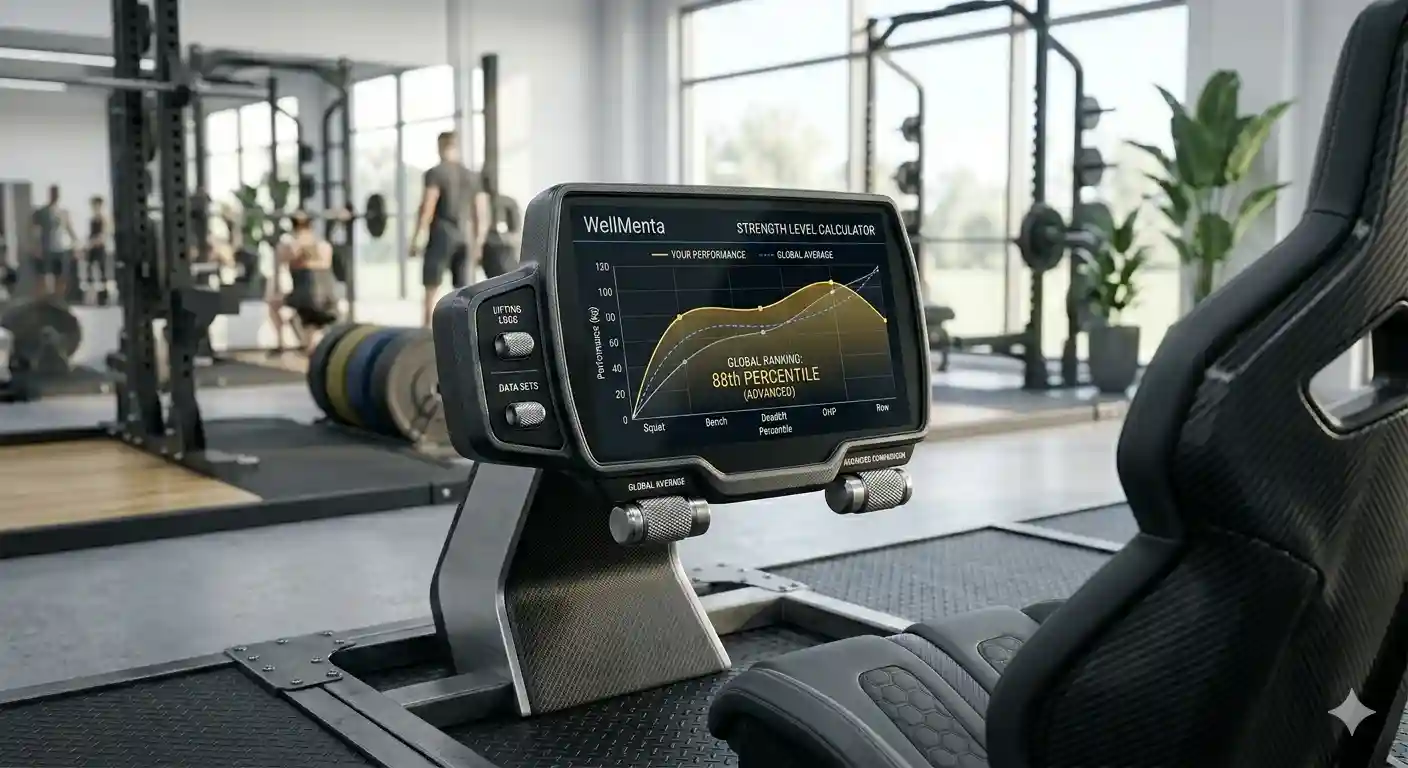
Strength Level Calculator
Compare your lifts with other lifters based on your body weight.
The Ultimate Guide to Strength Levels: How Do You Compare?
In the world of strength training, the question isn't just "How much do you lift?" but "How strong are you relative to your size?" Our Strength Level Calculator is designed to provide context to your gym progress by comparing your personal bests in the Bench Press, Squat, and Deadlift against thousands of other lifters.
The Importance of Relative Strength
Strength is often misunderstood. A 100 kg Bench Press is impressive for someone weighing 70 kg, but it is considered a baseline for someone weighing 120 kg. This is why strength standards by weight are the gold standard for measuring true athletic capability. By calculating the ratio between your body weight and the iron on the bar, we can determine your fitness benchmark.
The Three Pillars of Strength
Our calculator focuses on the "Big Three" compound movements because they are the most effective indicators of total body power:
- The Bench Press: The universal measure of upper body pushing strength.
- The Squat: The foundation of lower body power and core stability.
- The Deadlift: The ultimate test of posterior chain strength and raw pulling force.
What Do the Ranks Mean?
When you use our strength level standards, you will be placed into one of five categories. Here is what they represent in the lifting community:
- Beginner: You have just started your journey. You are stronger than about 5% of the general population but still learning the mechanics of the lifts.
- Novice: You have been training consistently for 6–12 months. You have moved past "newbie gains" and are starting to look like a lifter.
- Intermediate: The most common rank for serious gym-goers. You are stronger than 50% of lifters and likely have 1–2 years of structured training under your belt.
- Advanced: You are among the elite in most commercial gyms. This level usually requires years of dedicated programming and strict nutrition.
- Elite: You are stronger than 95% of lifters. People at this level often compete in powerlifting at a regional or national level.
Why Use a Strength Level Calculator?
Using an am i strong tool isn't just about ego—it’s about intelligent programming. If your Squat is "Advanced" but your Bench Press is "Novice," your data is telling you exactly where your training focus needs to shift. It allows you to set realistic, data-driven goals rather than picking numbers out of thin air.
FAQ: Strength Standards and Progress
Strength level calculators categorize your weightlifting performance into distinct athletic tiers based on your one-rep max relative to your body weight:
Beginner: You have mastered proper exercise form and have been training consistently for a few months.
Novice: You are stronger than the average population and have regularly progressed your lifts for up to a year.
Intermediate: You are stronger than the majority of gym-goers and have achieved several years of structured strength training.
Advanced: You are an elite lifter who has maximized your natural potential or actively competes in strength sports.
The calculator evaluates your strength by comparing your personal lift data against normalized, population-wide strength standards. It establishes your relative strength ratio by dividing the total weight lifted by your body weight, while also factoring in your biological sex and age bracket to ensure you are benchmarked against an accurate demographic peer group.
It is entirely normal to rank as an "Intermediate" on one lift and a "Novice" on another. This variation usually stems from structural leverages, muscle imbalances, or personal programming history. For example, individuals with long arms frequently rank higher on the deadlift but score lower on the bench press due to the distinct mechanical advantages inherent to their natural body proportions.
The weightlifting community frequently utilizes highly searched, bodyweight-relative milestones to define true baseline strength. For men, reaching the "1-2-3-4 plate club"—which equates to a 135-lb overhead press, 225-lb bench press, 315-lb squat, and 405-lb deadlift—is considered a monumental milestone. For women, standard strength targets often include a bodyweight bench press and a 1.5x bodyweight squat or deadlift.
Once the calculator identifies your current performance tier, you can optimize your training split and progression scheme. If you score as a Beginner or Novice, your body will respond best to simple, linear progression programs that add weight every single workout. If you rank as an Intermediate or Advanced lifter, your neuromuscular system requires complex, periodized routines that systematically vary volume and intensity over several weeks to force new adaptations.
Elevate Your Training
Data is the difference between working out and training. By using our Strength Level Calculator, you are transforming your gym sessions into a measurable quest for improvement. Whether you are a Beginner looking to hit your first bodyweight squat or an Advanced lifter chasing a 3x bodyweight deadlift, knowing your rank is the first step toward your next PR.