
LBM & FFMI Calculator
Calculate your Fat-Free Mass Index to determine your muscular potential.
Beyond BMI: Understanding Lean Body Mass and FFMI
For the serious athlete, weight is just a number. The real question is: what is that weight made of? While the Body Mass Index (BMI) is a useful metric for the general public, it fails to account for the difference between muscle and fat. This is why bodybuilders and strength athletes rely on the Fat-Free Mass Index (FFMI) and Lean Body Mass (LBM) calculations.
What is Lean Body Mass (LBM)?
Lean Body Mass is everything in your body that isn't fat. This includes your muscles, bones, organs, and water. Knowing your LBM is essential for several reasons:
- Metabolic Rate: Muscle tissue is more metabolically active than fat. The higher your LBM, the more calories you burn at rest.
- Nutrition Planning: Most protein requirements are based on your lean body mass calculator results rather than your total body weight.
- Tracking Progress: During a "cut," the goal is to lose fat while maintaining as much LBM as possible.
Understanding the FFMI Score
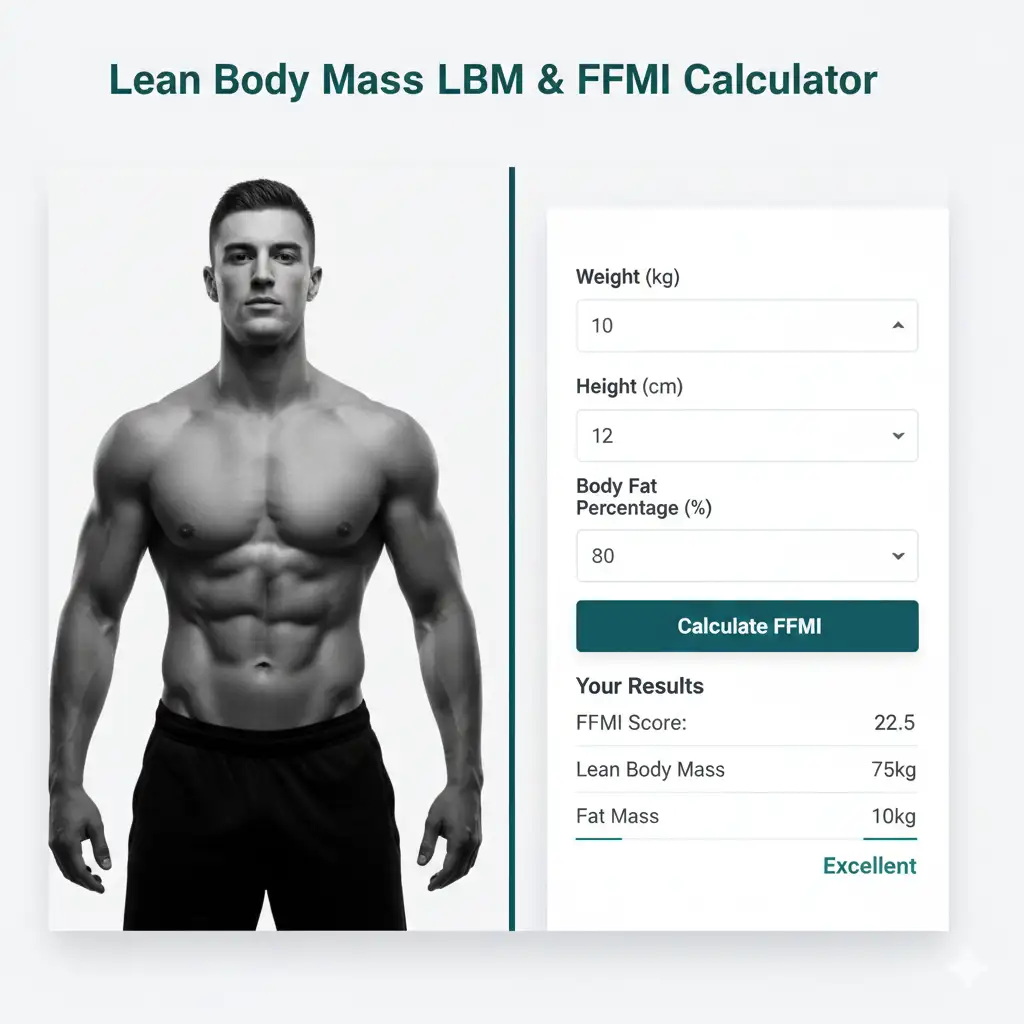
The Fat-Free Mass Index provides a normalized score that allows you to compare your muscularity to others, regardless of height. It is a powerful muscle potential calculator that helps you understand where you stand in your fitness journey.
The FFMI Scale (For Men):
- 18–19: Average muscularity.
- 20–21: Above average; likely someone who trains consistently.
- 22–24: Excellent; represents the peak of what most natural lifters can achieve.
- 25–26: The "Natural Limit"; historically, very few natural athletes exceed a 25.0 FFMI.
- 27+: Superior muscularity; often associated with professional athletes or those using performance-enhancing aids.
FAQ: Muscle Mass and FFMI
What is the difference between Lean Body Mass (LBM) and Fat-Free Mass Index (FFMI)? Lean Body Mass (LBM) is the absolute weight of your body minus your fat mass, expressing your muscles, bones, organs, and water weight in pounds or kilograms. Fat-Free Mass Index (FFMI) takes your LBM and scales it relative to your height FFMI = Fat-Free Mass (kg) / Height (m)^2. This normalization allows you to objectively evaluate your true muscularity regardless of how tall or short you are.
Body Mass Index (BMI) evaluates health strictly by dividing total weight by height squared. Because it cannot differentiate between fat and muscle mass, highly muscular lifters are frequently misclassified as overweight or obese. FFMI solves this limitation by factoring in your body fat percentage, providing an accurate representation of an athlete's physical condition and real muscle development.
FFMI scores vary based on your training experience and biological sex:
For Men: An average untrained score ranges from 18 to 20. Dedication to strength training can elevate this to an excellent score of 22 to 24, while a score of 24 to 25 represents elite natural levels.
For Women: Average scores typically range from 15 to 16.9. A score of 17 to 18.9 represents a highly trained, athletic physique, while anything between 19 and 21 is considered elite natural level.
Scientific research regarding natural bodybuilders and elite athletes suggests that a normalized FFMI score of 25 serves as a soft ceiling for natural human muscle growth in males. While rare genetic outliers may slightly exceed this threshold without assistance, consistent scores above 25 are frequently utilized in professional competitive sports to flag potential performance-enhancing drug use.
The mathematical outputs of an online LBM and FFMI tracker are entirely dependent on the quality of your initial body fat percentage entry. Underestimating your body fat percentage will artificially inflate your calculated lean mass and result in an inaccurately high FFMI score. For the best results, utilize a reliable source data input, such as hydrostatic weighing, a DEXA scan, or consistent skinfold caliper measurements.
Data-Driven Bodybuilding
In the pursuit of the perfect physique, you cannot manage what you do not measure. By using our FFMI Calculator, you move beyond the mirror and into the realm of objective data. Use your score to set realistic goals, refine your nutrition, and push toward your true genetic muscle potential.